
Nobody calls to tell you that you are losing.
That is the part too many beverage alcohol brands still misunderstand. Retail does not fire you with a dramatic meeting. The buyer does not send a warning flare. The account just starts believing in you a little less.
Facings disappear. Reorders get smaller. Displays do not come back after reset. The brand that looked safe in a national account review suddenly becomes dead weight in the set.
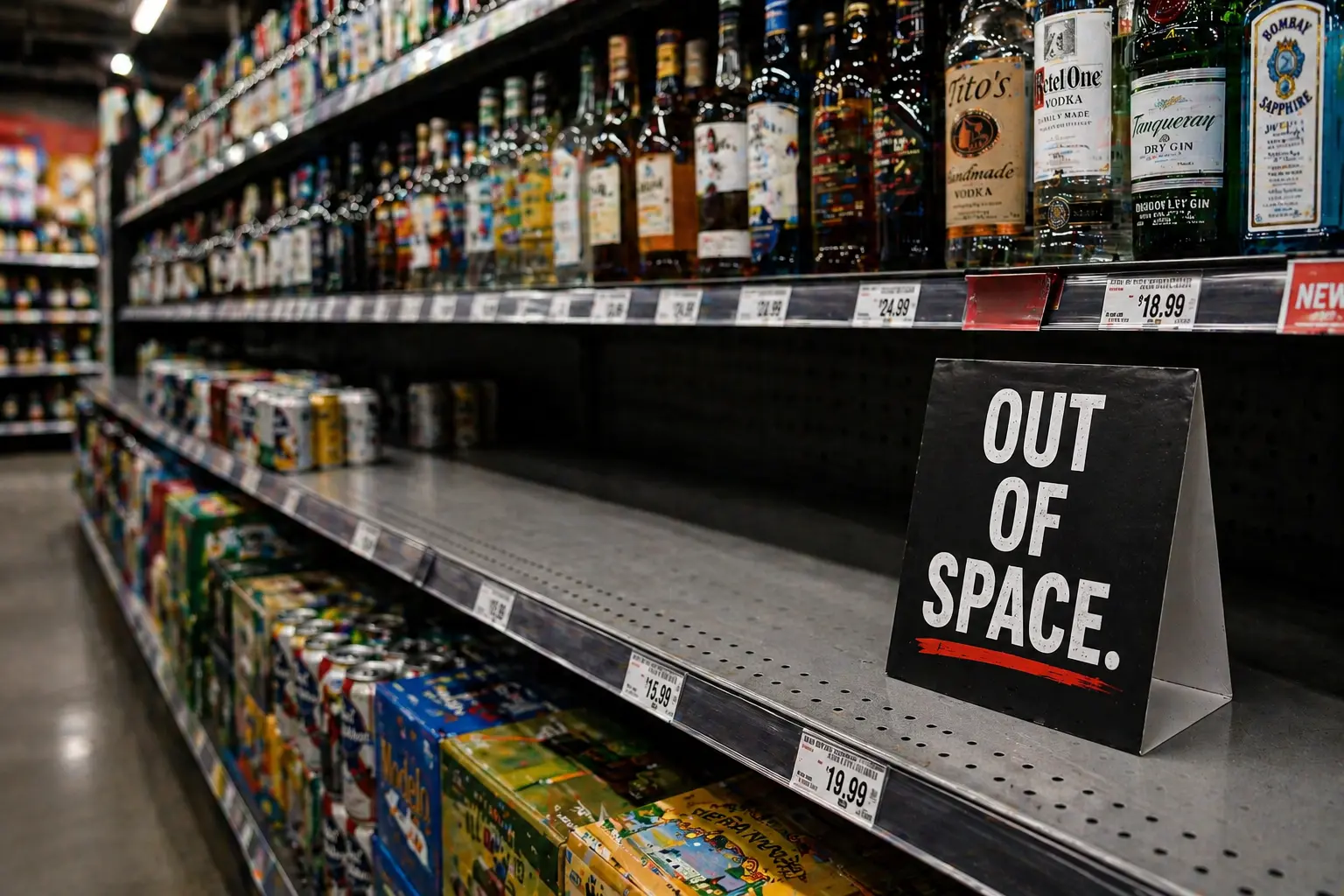
That is what makes shrinking retail shelf space so dangerous. Most suppliers do not see the cut coming because it happens quietly, store by store, before it ever shows up in the topline report.
The Silent Reset Is Already Happening
Chain buyers are not sentimental. Time in the set does not protect a brand. A great sell-in story does not matter if the product is not earning its space after the reset.
Retailers care about the filters that keep their business clean: velocity, margin, and simplicity. If a brand helps those three things, it has a case to stay. If it makes the set harder to manage or fails to move fast enough, it becomes vulnerable.
That pressure is getting tighter across grocery, liquor chains, and big-box retail. Buyers want fewer slow movers, cleaner shelves, stronger turns, and less operational noise. They are not looking for brands with potential forever. They are looking for brands that perform now.
The shift is not loud. That is what makes it dangerous.
Retailers Are Not Grading Your Brand Story
Let’s kill the myth. Retailers are not evaluating your brand the way your marketing team evaluates it.
They are looking at how fast it sells, how easy it is to manage, and how much money it makes the account. That is the scoreboard. Everything else is support material.
If your product requires too much explanation, too much hand-holding, or too much effort to move, it is already at risk. Retail has more options than ever. Private label is stronger. Category sets are crowded. Buyers are choosing efficiency over hope.
A brand can have a strong identity and still lose shelf space. A product can have loyal fans and still get cut. A supplier can have a good relationship and still watch a competitor slide into its space.
The shelf does not reward the best story. It rewards the brand that turns.
The Cut Usually Looks Smaller at First
Retail shelf losses rarely start as a total exit. They usually begin with little signals that are easy to explain away.
One facing becomes fewer facings. A secondary display disappears. A store that used to reorder weekly starts stretching inventory. A feature does not come back. A reset moves the product from a strong position to a forgettable one.
None of those signs looks fatal by itself. Together, they are the account telling you what the buyer may not say directly: the brand is losing confidence.
By the time the national team notices, the decision may already be moving through the system. The brand is not necessarily performing badly. It is just not performing well enough to defend the space.
That is the bar now.
Most Brands Watch the Wrong Signals
Suppliers usually see the problem late because they are watching lagging indicators. Shipments, distributor feedback, and topline sales all matter, but they can hide what is happening at store level.
The real warning signs live closer to the shelf:
- Facings decline before the brand officially loses distribution.
- Out-of-stocks create missed sales that never show up as demand.
- Secondary placements disappear before anyone updates the plan.
- Store-level execution gaps weaken the buyer’s confidence.
- Reorders slow down while the supplier is still celebrating account coverage.
This is why retail visibility matters. If you do not know what is happening in the store, you are managing the business through a rearview mirror.
Discounting Is Not a Visibility Strategy
When sales slow down, the predictable move is to cut price. It feels like action. It gives the team something to point to. It may even create a short-term bump.
But discounting does not fix weak visibility, poor placement, execution gaps, or a product that is not being supported locally. It just buys time, and usually not much.
Worse, excessive discounting can teach the retailer the wrong lesson. The product only moves when it is cheaper. That is not a win. That is a warning sign.
Brands need to be careful here. Price can be a useful lever, but it cannot become the only proof of demand. A brand that relies on discounting to survive the shelf is already negotiating from a weak position.
Winning Brands Move Before the Reset
The brands that survive shrinking shelf space are not always the loudest. They are the tightest.
They know which stores are moving product, which ones are slipping, and why. They simplify the retail story so the buyer has one clear reason to keep them in the set. They verify execution instead of trusting assumptions. They act before the reset makes the problem official.
That is the difference between managing distribution and defending it.
Winning brands build a habit around account-level proof. They track where the product is placed, whether promotions are live, how displays are executing, and where local consumer demand is supporting the retail footprint. They do not wait for the buyer to say the brand is under review.
Shelf space is not lost in a meeting. It is lost in the store, one missed execution at a time.
The Real Problem Is the System
This is bigger than one bad reset or one tough buyer. The real issue is that too many beverage alcohol brands lack a system for seeing and proving what is happening across accounts.
No consistent shelf visibility. No reliable proof of placement. Slow communication between supplier, distributor, and retailer. Limited ability to connect local activation to store-level movement.
That is not just a sales issue. It is a system issue.
In today’s retail environment, systems decide who stays and who gets replaced. The brand that can prove execution, support the right accounts, and show movement has a stronger case. The brand that waits for the next shipment report is already behind.
AppyHour helps beverage alcohol brands close that gap. We help brands activate around real retail footprints, surface local promotions to nearby consumers, and create a clearer account-level story around visibility, demand, and movement. Stop asking only how to win more distribution. Start proving why retail should keep what you already earned.u don’t have any.