

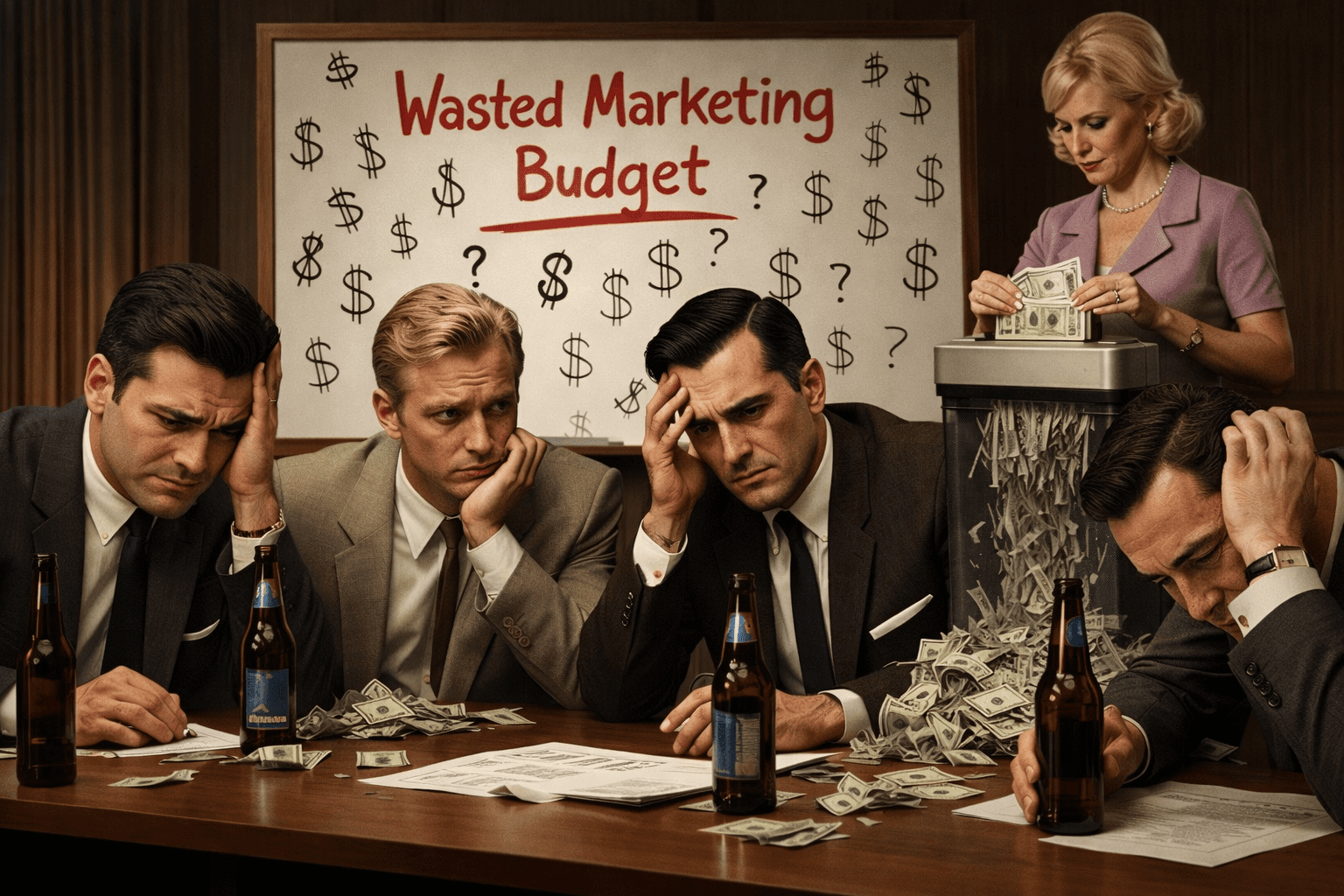
In 2026, the beverage alcohol industry invests billions in marketing, with over 60-70% shifting to digital channels. Yet up to 70% of total spend—and $26.8 billion globally in programmatic alone—often wastes away due to inefficiency, poor targeting, and out-of-context delivery. Traditional channels compound the problem, missing the moment when consumers decide where to go and what to drink.
Proven Inefficiencies Supported by Data
If you work in beverage alcohol, you already know the drill: big budgets, big campaigns, big decks, big checks… and very fuzzy answers. Up to 70% of a typical bev-alc marketing budget is effectively lost on traditional spend—failing to reach the right consumer, in the right place, at the right time, and providing no value that help your bar, restaurant, and retail partners succeed.
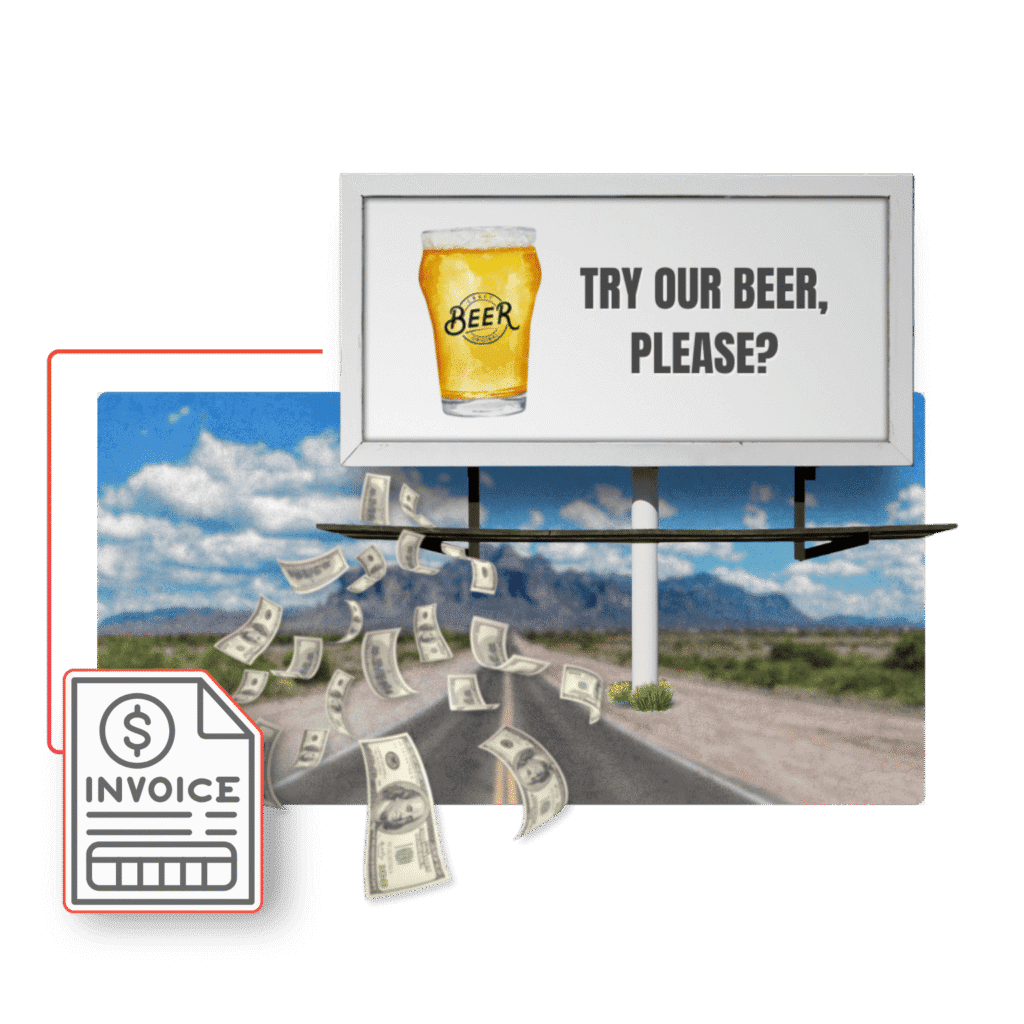
Traditional channels miss the mark and provide little value for retailers and consumers.
Radio:
86% of listeners change stations, lower volume, or zone out during ads—no attribution or consumer insights. It’s background noise, not brand-building.
Billboards:
Only 12-20% of drivers actively process content; recall varies widely with no direct tracking or behavioral data. Great for ego. Terrible for performance.
Print & POS:
Materials frequently unused or discarded—expensive production yields zero accountability or engagement insights. It’s all visibility with no accountability.
TV and Entertainment:
Fragmented viewership, high skip rates, and declining reach make ROI elusive despite premium costs—no real-time consumer feedback. Brands spend big, but rarely get a clear return.
These channels reach consumers out of context—far from the decision moment—and provide no data or insights to help brands understand preferences, refine activations, or secure more retail priority.
The uncomfortable truths about digital channels for bev-alc marketing and activation spend.
Digital is now the dominant channel for alcohol brands, with 61% of U.S. alcohol ad spend flowing into digital. The Current. But “spent” and “seen” are not the same thing.
Paying to shout into the digital void
- More than 56% of digital ad impressions are never even viewed by a real person. Marketing Evolution
- Over 56% of impressions often non-viewable; 40-60% generate no ROI from fraud and misattribution.
- ANA 2025 benchmarks: $26.8B global programmatic waste (up 34% in two years)—fees and low-quality inventory siphon value, delivering impressions without consumer behavior, market trends, or sales impact data.
So even before you ask “Did this move any cases?”, a huge chunk of your digital budget never has a fair shot. It’s either never seen, seen by the wrong consumer, or seen totally out of context—like a cocktail ad served to someone scrolling in bed on a Tuesday morning.
Complex ad tech, hidden fees, and misrepresented value
A recent ANA study found that nearly 60% of programmatic ad spending is still “wasteful,” siphoned into tech fees, overhead, and bogus traffic rather than reaching the intended audience. (Ana) Similarly, analysis of hundreds of millions of dollars in digital ad spend found that over 15% of budgets went to inventory that generated no value at all (Ebiquity). For bev-alc brands, that means:
- You pay for access to audiences you never truly reach.
- You fund a tech ecosystem that’s largely disconnected from what matters: pulling your product through a bar tap, backbar, or cocktail menu.
You’re not paying to reach your target audience of drinkers. You’re paying to fund a complex machine whose incentives don’t always line up with selling more pints, pours, and cases.
Fleeting consumer attention, wrong moments, no attribution
On paper, digital looks great: audiences, frequency, reach. In reality:
- Consumers are bombarded with hundreds of ads per day.
- Ad fatigue kicks in after only 3min of scrolling
- Many respond by mentally filtering them out (“banner blindness”) or blocking them entirely. HubSpot
For beverage alcohol, the timing and setting of the message are everything, yet much of today’s bev-alc spend is optimized for CPMs and click-through rates, not capturing the moment when someone is deciding where to go and what to drink.
- A tequila ad is much more powerful when someone is looking for margarita specials, in the tequila section at liquor store not when they’re half-watching TV or skimming social at work.
- Alcohol purchase and trial are often contextual, social and location-driven—the decision happens with occasions, friends, and settings: in a bar or restaurant, or at a retail store.
Under-utilization of trade marketing, lack of continued support
On-premise is still the “holy grail” of alcohol sales and brand building. Industry guides repeatedly emphasize that bars and restaurants are where brands can create deep engagement and long-term loyalty (snipp.com+1). But that doesn’t mean every on-premise dollar is well spent when considering the common pain points:
POS clutter:
Many bars already have crowded backbars and tabletops. POS materials that don’t help the bar function often end up in storage, not on display. Global Drinks Intel
One-off events:
You host a pricey activation, give away swag, maybe buy a band and a backbar display… and then what? There’s often no ongoing digital connection or clear line of sight to repeat visits.
Operator disconnect:
Data shows that around 58% of on-premise customers ask bartenders for recommendations. Global Drinks Intel+1 If your spend doesn’t make the bartender’s life easier or more profitable, it’s just noise.
Bars and restaurants don’t just want branded stuff anymore. They want:
- Continued support from brand placements
- Promotions that are easy to execute
- Consumer awareness to help drive product sales
- Tools that help them stand out in a crowded market
When your marketing and activation spend don’t support those goals, it’s at risk of being shelved.
No clear line from spend to ROI
When looking at your activation spend, here are the questions you, your distributors, and retail partners want to know:
- Did the spend drive sales lifts across retailers in the market?
- How did the spend support our partners?
- Where is the data to support spending more?
- Should we expand this spend into more markets?
When the answer is “We’re not sure,” that’s where the rest of the waste hides. The campaign might look great in a recap deck, but if your distributor, retail partner, or internal team can’t tie it to velocity, attribution, retail value-add, or consumer insights, the ROI is opaque at best.
What Wins: Contextual relevancy. Consumer intent. Retail proximity. Actionable data.
In an era where $26.8 billion in programmatic spend alone goes to waste and traditional channels deliver marginal actionable insights, the biggest gap for beverage alcohol suppliers is clear: channels that activate consumers with context, proximity to purchase, and near the moment of decision—when they’re actively planning where to go, and what to drink— will outperform any other spend.
Forward-thinking suppliers will allocate budgets to channels that offer more value
- Hyper-local, high-intent, contextual consumer reach
- Value-added retail support that stimulates account sell-through
- Deep analytics that drive marketing optimization and enable sales
- Data on consumer preferences, pricing, and product interest across markets AppyHour
By reallocating even a portion of wasted spend to these intent-driven, proximity-based channels, suppliers turn fragmented budgets into measurable velocity: the right drinker, in the right venue, at the right moment—with the intelligence to win more business.
Instead of shouting into oversaturated channels, put your brand directly in front of consumers who are already asking, “Where should we go—and what should we drink?”
